





Deciphering the cannabinoid jargon
Ever since hemp was legalized back in 2018, it seems you can’t go a day without hearing about CBD or seeing it appear on the counter of yet another store or gas station. Between the gummies, tinctures and alphabet soup of CBD, THC, CBG and CBN, it’s easy to feel like everyone else got a cannabinoid glossary you missed.
Once you know the difference between cannabinoids, phytocannabinoids, and endocannabinoids, the rest of the cannabis conversation gets much easier to follow, including the research on their potential benefits.
In this article, we’ll break down what each term means, where each compound comes from, and how they interact with the body.

Difference between Cannabinoids vs Endocannabinoids vs Phytocannabinoids
When it comes to defining the different types of cannabinoids, they can be split into three main groups, depending on where they originate:
Cannabinoids – Biologically-active chemical compounds found only in cannabis and hemp
Endocannabinoids – Neurotransmitters, similar to cannabinoids, that interact with cannabinoid receptors in our endocannabinoid system
Phytocannabinoids – Biologically active chemical compounds found in any plant that have cannabimimetic properties, meaning they are similar to cannabinoids via their interaction with the endocannabinoid system and/or their chemical structure.
What are cannabinoids?
If you look for a phytocannabinoids definition in the dictionary, you won’t find one. Although you may find a definition for cannabinoids, which, according to the Merriam-Webster dictionary, is:
1: any of various naturally-occurring, biologically active, chemical constituents (such as cannabidiol or cannabinol) of hemp or cannabis including some (such as THC) that possess psychoactive properties
2: a substance that is structurally or functionally similar to cannabinoids derived from hemp or cannabis
Cannabinoids were first discovered in the cannabis plant back in the 1940s and over the years, scientists have discovered many more, some of which are more abundant than others.
Until recently, the most famous cannabinoid of all was delta-9 THC (also known simply as THC). It is one of the most common cannabinoids that can be found in cannabis and was the most widely studied for many years because of its strong psychoactive effects. Scientists were keen to learn how and why it was able to intoxicate us.
Despite being discovered earlier than THC, CBD stepped into the spotlight after research showed it could reduce seizures in certain rare forms of epilepsy, leading to Epidiolex, the first FDA-approved CBD-based medication. CBD is found in cannabis, but it and many other cannabinoids can also be found abundantly in hemp, hence the recent influx of hemp-derived CBD products.
However, there are at least 144 known major and minor cannabinoids that can be found in cannabis and hemp plants, including CBG, CBN, CBC, CBDV, and THCV.
What are endocannabinoids?
Opioid receptors were discovered in 1973, but it wasn’t until 1988 in a rat-brain study that Allyn Howlett and William Devane discovered receptor sites in the rat brain that responded to these chemical compounds found in cannabis.
These receptors, aptly named cannabinoid receptors, were part of the super-family of G protein-coupled receptors, alongside dopamine, serotonin, adrenaline, and opiate receptors (to name a few). It wasn’t too much longer before scientists realized that these cannabinoid receptors were actually among the most abundant neurotransmitter receptors in the brain.
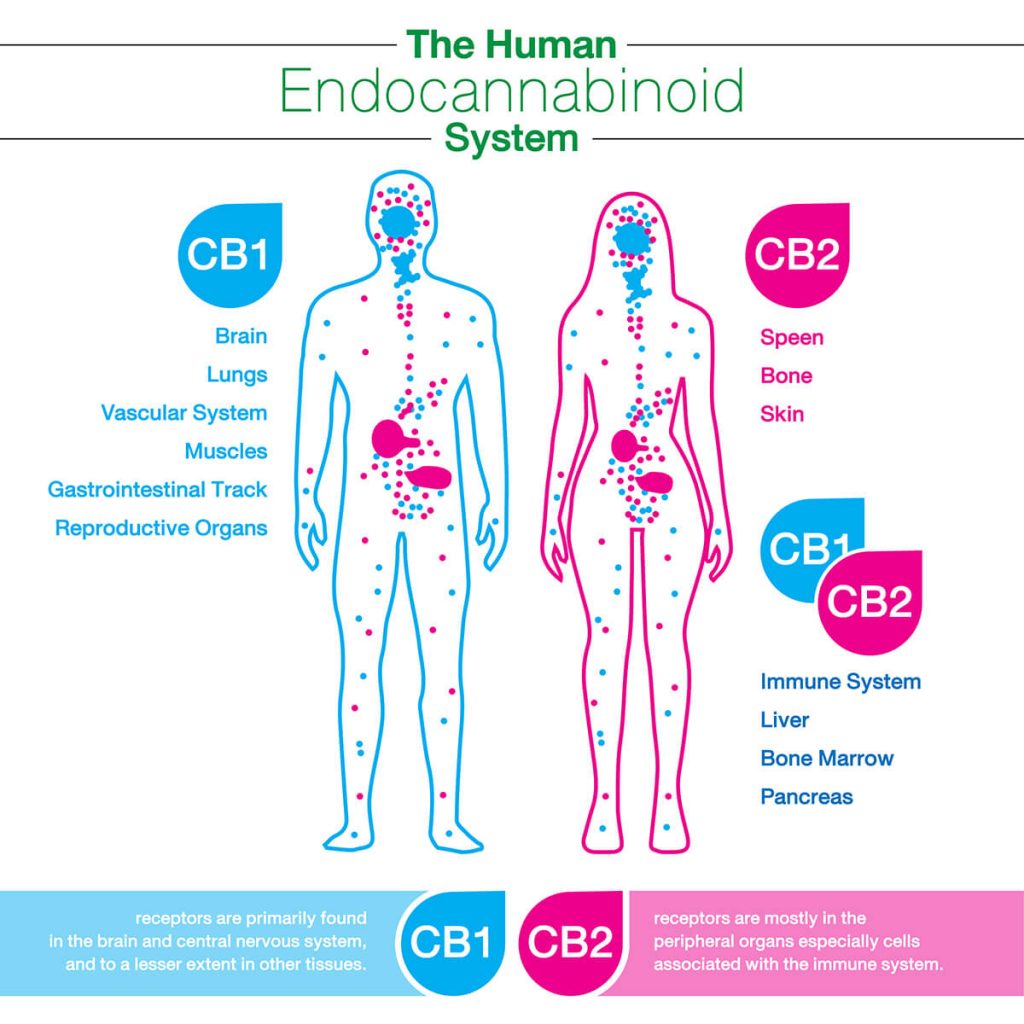
Receptor cloning and studies in genetically modified mice later confirmed that THC works by activating cannabinoid receptors. Around this time a second type of cannabinoid receptor was also discovered (cannabinoid receptor 2 or CB2) mainly on immune cells and in peripheral tissues.
It occurred to some scientists that the presence of cannabinoid receptors in our bodies suggested that we must produce our own chemical compounds that interact with them. Surely we wouldn’t have evolved these receptors for the sole reason of interacting with the cannabis plant?
They were right. In 1992 the first endogenous cannabinoid, or endocannabinoid, was discovered. It was named anandamide, from the Sanskrit word ananda meaning bliss, and was followed shortly thereafter by the discovery of 2-arachidonoylglycerol (2-AG) in 1995, as well as a handful more.

Introducing the endocannabinoid system
By proving that our brain and bodies produce cannabinoids that interact with cannabinoid receptors, a team led by Raphael Mechoulam, including Lumír Hanuš and William Devane, identified the existence of a previously unknown molecular signaling system in our bodies, the endocannabinoid system (ECS).
Research suggests that the endocannabinoid system helps regulate a wide range of cognitive and physiological functions that help our bodies maintain a state of balance, or homeostasis, despite constant fluctuations in our external environment.
When the ECS detects an imbalance, it synthesizes endocannabinoids to send messages via receptors to stimulate a chemical response in order for our bodies to return to homeostasis. However, some researchers have proposed that problems with endocannabinoid signaling could contribute to certain conditions, an idea known as Clinical Endocannabinoid Deficiency (this theory is still debated but remains unproven at this time).
More on the endocannabinoid system
The endocannabinoid deficiency theory
Under this theory, a deficiency could arise for several reasons, including when:
- our body isn’t producing enough endocannabinoids
- our body isn’t producing enough cannabinoid receptors
- our body is producing too many enzymes that are responsible for breaking down our endocannabinoids
What are phytocannabinoids?
Until recently, cannabinoids were the only plant natural compounds that were known to directly interact with our cannabinoid receptors, but scientists have now discovered other plant natural products, outside of cannabis and hemp, that also interact with these receptors. They have been found in some flowering plants, liverworts, and fungi.
This prompted the new definition, phytocannabinoids, to be coined, with the word phyto deriving from the Greek word for “plants” phyton.
By adding this prefix, the term phytocannabinoids refers to all plant-derived compounds (not just those found in cannabis and hemp), capable of interacting with our cannabinoid receptors, and/or that share a chemical similarity with cannabinoids.
How many phytocannabinoids have been discovered?
So far, at least 144 cannabinoid compounds have been discovered within cannabis and hemp, but other types of phytocannabinoids have also been found in other plant sources, including;
- Echinacea purpurea
- Echinacea angustifolia
- Echinacea pallida
- Acmella oleracea
- Helichrysum umbraculigerum
- Radula marginata
- Rhododendron dauricum
- Rhododendron anthopogonoides
- Cylindrocarpon olidum
- Black truffles
…to name just a few.
The most famous phytocannabinoids that exist outside of cannabis and hemp are lipophilic alkylamides found in the echinacea genus of plants, which are structurally similar to anandamide.
Preclinical research has shown that these compounds bind selectively to CB2 receptors and that Echinacea alkylamides can also affect endocannabinoid transport and breakdown.

What are the potential benefits of phytocannabinoids?
Researchers have found that the endocannabinoid system is involved in a wide range of physiological processes, which has led to it being studied in many different conditions.
One team of researchers said that “modulating ECS activity holds therapeutic promise for a broad range of diseases, including neurodegenerative, cardiovascular and inflammatory disorders, obesity/metabolic syndrome, cachexia, chemotherapy-induced nausea and vomiting, tissue injury and pain, among others”. Many of these ideas are still at an early stage.
Some researchers have suggested that supplementing with phytocannabinoids could support endocannabinoid tone, but this is still a hypothesis and hasn’t been proven in clinical research.
To truly understand the potential therapeutic benefits that could be offered by phytocannabinoids, we need to learn more about the role of the endocannabinoid system and how these compounds interact with it.
Research shows that the endocannabinoid system plays a role in regulating a wide range of essential functions, including memory, mood, sleep, inflammation, pain sensation, motor skills, and immune response, which is why scientists are concentrating their research within these areas in particular.
Phytocannabinoids dosage
There is no established dose of CBD or other phytocannabinoids for general use, and responses vary with body weight, metabolism and other factors. If you’re considering a cannabinoid product, speak to your doctor or pharmacist first, particularly if you take other medication.
Because there isn’t a one-size-fits-all dosage, it’s very important to work out your ideal dosage by starting with the lowest dose on the label and increasing gradually.
Keeping a diary over this time can be very useful in helping you remember what dose you’ve taken, as well as any changes in how you feel.
References
- Merriam-Webster. Definition of “cannabinoid”. Merriam-Webster
- Devinsky O, et al. (2017). Trial of cannabidiol for drug-resistant seizures in the Dravet syndrome. New England Journal of Medicine, 376:2011–2020. NEJM
- A new ESI-LC/MS approach for comprehensive metabolic profiling of phytocannabinoids in Cannabis (2018). Scientific Reports. Nature
- Devane WA, Dysarz FA, Johnson MR, Melvin LS, Howlett AC. (1988). Determination and characterization of a cannabinoid receptor in rat brain. Molecular Pharmacology, 34(5):605–613. PubMed
- Devane WA, et al. (1992). Isolation and structure of a brain constituent that binds to the cannabinoid receptor. Science, 258(5090):1946–1949. PubMed
- Russo EB. (2016). Clinical endocannabinoid deficiency reconsidered: current research supports the theory in migraine, fibromyalgia, irritable bowel, and other treatment-resistant syndromes. Cannabis and Cannabinoid Research, 1(1):154–165. PubMed Central
- Gertsch J, Pertwee RG, Di Marzo V. (2010). Phytocannabinoids beyond the Cannabis plant – do they exist? British Journal of Pharmacology, 160(3):523–529. PubMed
- Raduner S, et al. (2006). Alkylamides from Echinacea are a new class of cannabinomimetics: cannabinoid type 2 receptor-dependent and -independent immunomodulatory effects. Journal of Biological Chemistry, 281(20):14192–14206. Journal of Biological Chemistry
- Chicca A, et al. (2009). Synergistic immunopharmacological effects of N-alkylamides in Echinacea purpurea herbal extracts. International Immunopharmacology, 9(7–8):850–858. PubMed
- Pacher P, Kunos G. (2013). Modulating the endocannabinoid system in human health and disease: successes and failures. FEBS Journal. PubMed Central